
Jacob's Ladder
What is a Jacob's Ladder?
The Jacob's Ladder - also known as a high voltage travelling arc, is a staple of any mad scientist's workshop. As its' proper name implies, it is effectively an arc of high voltage travelling along 2 electrodes upwards caused by the electrical breakdown and hence a path of ionisation which allows the arcs to continuously rise until either it reaches the ends of the electrodes or the path of ionisation becomes too distant to reach the current threshold, causing it to break.
The electrical arcs formed are plasma - resultant from the ionisation of oxygen (O2) into ozone (O3). This electrical breakdown of air per mm is often 3kV/mm - assuming standard atmospheric pressure and average room humidity; the voltage required for breakdown between 2 electrodes is dictated by Paschen's law wherein the breakdown voltage between 2 electrodes in a given gas becomes a function of pressure and gap length. This relation produces a graph curve (Paschen's law) which shows that breakdown voltage is mostly proportional when graphed against pressure or gap length respectively.
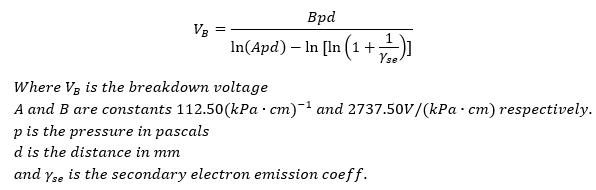
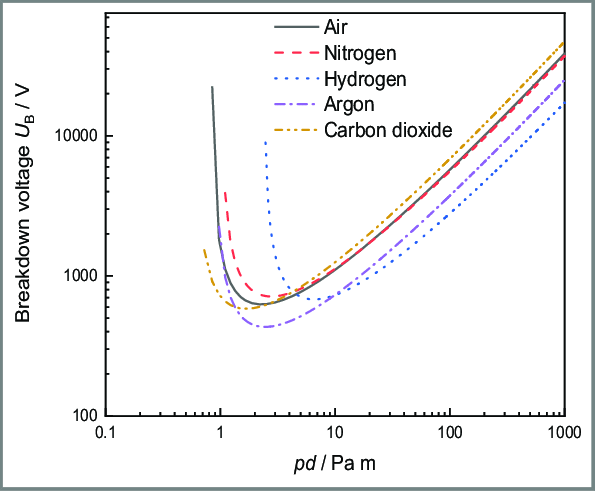
As you may have seen in videos of Jacob Ladders, the arc typically re-strikes at the base of contact - after being extinguished; this occurs for every half-cycle of an AC where the arc extinguishes momentarily at the 0 point twice per cycle - however, because of the effect of ionisation, the arc does not immediately disappear, instead persisting until it reaches the electrode's ends or the ionised path becomes too distant. After being extinguished, for every other half-cycle, the arc re-ignites at the base of contact, travelling once again.
Nov. 29, 2025
This project is relatively simple in comparison to others I'm working on; but either way, it makes for a cool demonstrative piece to add to my arsenal of "black magic gizmos".
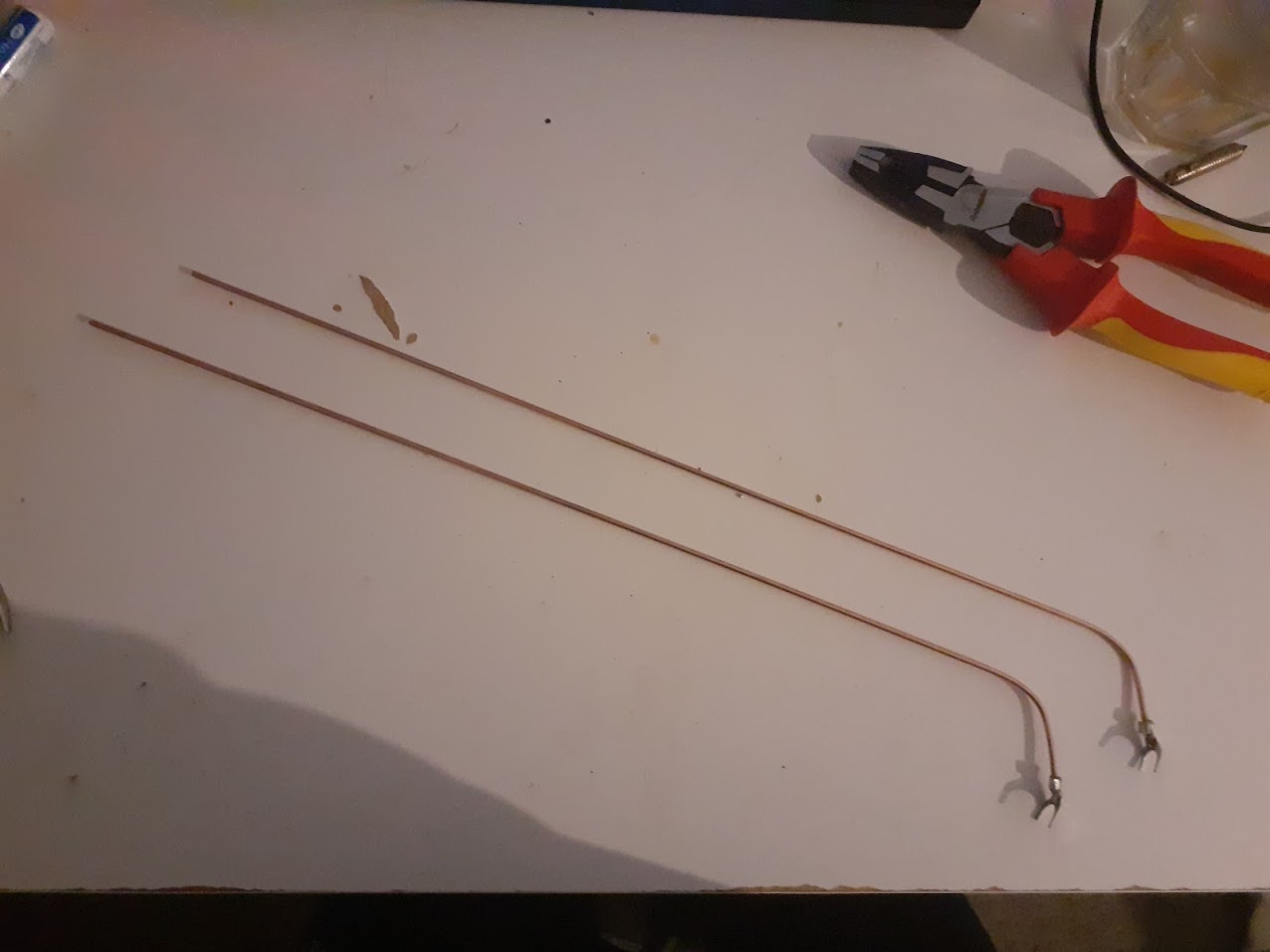
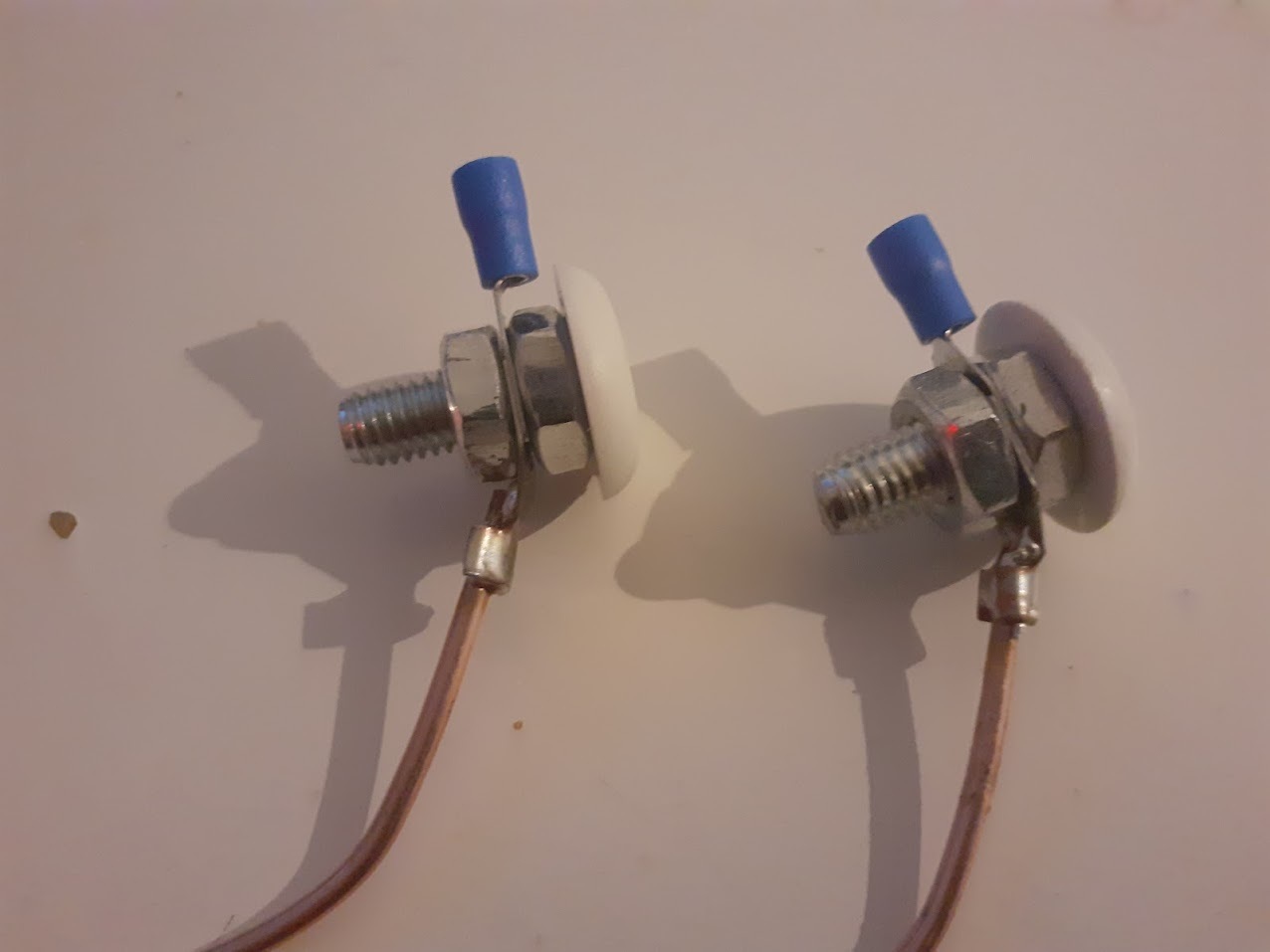
I concerned myself with the electrodes first. I got myself a set of brass welding rods I had lying around my workshop that I hadn't used before, figuring that they would make for decent electrodes. I bent them into shape by using an induction heater from an earlier project - shaping them in a way that the base of contact would be distant enough from the terminals. I also soldered a fork spade connecter to each rod and made a terminal using an IKEA bolt I had, and another fork spade connector to wire the transformer to.
Dec. 10, 2025
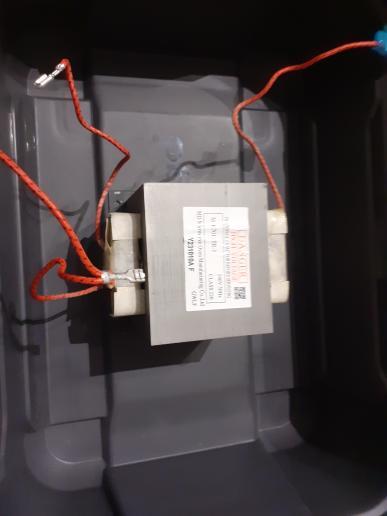
I've been putting this project on hold for a decent while due to coursework and finding a decent seller on facebook marketplace who would respond to me but eventually I did. I got my hands on a 700W microwave and disassembled it for a MD-701FTR-1 transformer, rated for an input of 240V with an electrical frequency of 50Hz.
I built my electrode setup, fixing the 2 electrodes onto a wooden box that I intended on using to fit the transformer to make a one-piece system - but it ultimately ended up being too small. Regardless, I used the power lead from the microwave to connect it to the live and neutral lugs of the transformer. Stripped another spare lead I had for the live and neutral cables, and soldered them respectively to the fork spades of the electrode's terminal. With that done, I rigged the system up with some crocodile clips, connecting one electrode terminal to the HV lead of the secondary coil and the other to the base of the transformer.
Conclusions
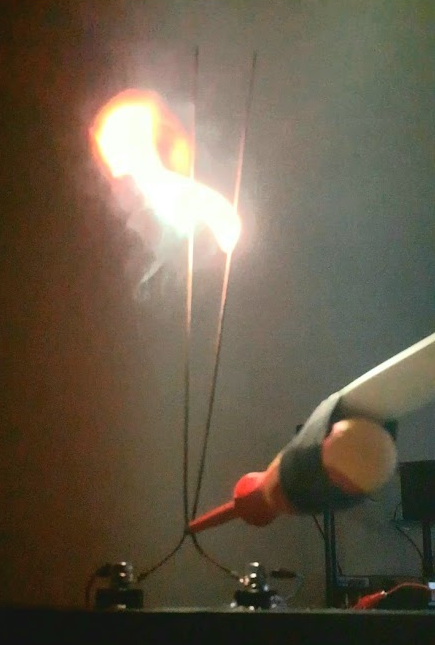
As keen eyed readers may have noticed, I've used what has aptly been named "the jesus stick" to start the arc - made with electrical tape, a plastic pole and an insulated screwdriver. This was largely due to the fact that the voltage wasn't sufficient enough to initiate a jump (breakdown voltage). Recall Paschen's law, where pressure and gap length dictate if a volt jump can occur in the first place. Aditionally, recall the fact that 3kV/mm is the typically the minimum requirement in indoor environments to initiate such a jump. A typical microwave transformer only has the output of 2.4kV as opposed to the desired 3kV+; as such, I can resolve the problem by either: Placing a candle in between to ionise the air and initate a jump, put 2 transformers in series to theoretically "double" the voltage; or put the system in a pressure chamber and adjust until I achieve the breakdown voltage at some fixed gap distance.
I find the the former and latter to be either boring or too convoluted so, if I ever get the chance to, I will be connecting 2 transformers in series for flashier and cooler looking arcs.